Category Archives: Psychology

Peter Hadfield versus Tom Nelson

This article not directly related to Arctic sea ice, but instead is one of our (very!) occasional series on the psychology of anthropogenic global warming “skepticism”.

Peter Hadfield is better known as the man behind Buster Keaton’s face on the “Potholer54” channel on YouTube. Tom Nelson is the “producer” of Martin Durkin’s “Climate: The Movie”. Peter produced a video criticising that movie. Many months later Peter and Tom have just recorded a “long-form, man-to-man debate” via Zoom about those criticisms. Here is episode 1 of Potholer’s version of events:

Here is “Snow White’s” hot take on the first 10 minutes of Tom Nelson’s version of events on X (formerly Twitter):

In brief, Tom seems to be incapable of providing a straight answer to a straight question, and instead loudly rails against what he continually refers to as the instrumental temperature “spike of doom”.

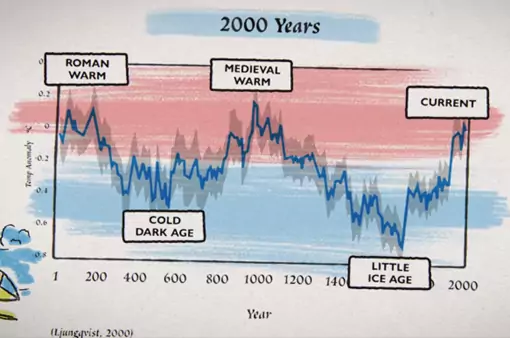
Can you spot the difference between these two graphs? The first is from Ljungqvist (2010):
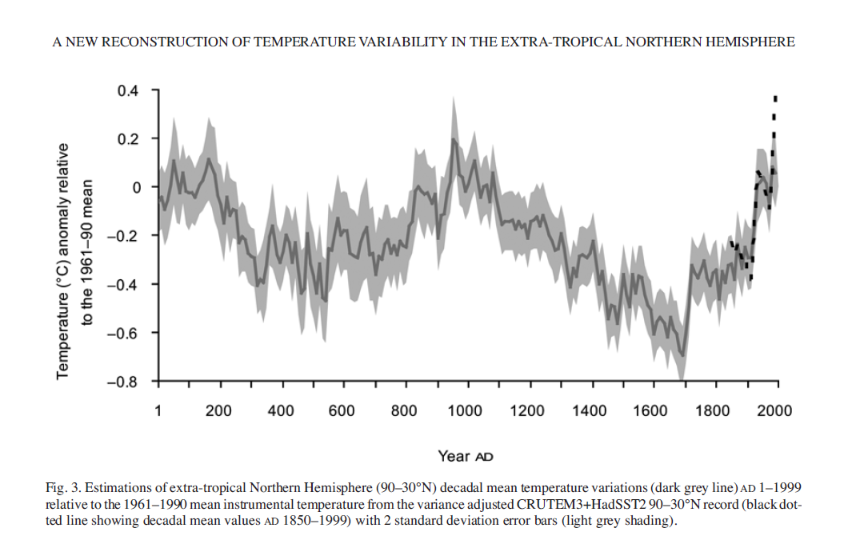
The second is from Climate: The Movie (The Cold Truth):
[Update – May 5th]

Note that at 2:18 in the video above Tom says:

I want to make sure that my audience hears everything that you have to say, so I’d hope that we don’t filibuster and try to keep our answers short and snappy.

Here’s the second episode of the Peter v Tom “debate”:

Would anybody here care to run a stopwatch past the time spent “filibustering” by each of the two participants?

In the video description Peter has this to say:

During the debate, Tom asked me a gish-gallop of questions, including whether I ‘believe’ CO2 is the control knob of global temperature, and about the Medieval Warm Period, and the weather, etc. He did not choose any of these as topics for the debate…

So why didn’t I simply answer all his questions and explain this? Because I have had 40 years experience interviewing politicians and government officials, whose strategy is always to divert attention onto another subject whenever you are homing in on a contradiction or a mistake. Even if I had taken the bait and explained what the science actually shows regarding the weather, or the control knob, or the MWP, as soon as I got close to busting another of Tom’s fallacies, he would have interrupted me mid-sentence to try to divert onto another subject. The trick is to always keep them on the topic.

Here’s are Peter’s subsequent musings on the “debate”:


Here’s an excerpt from Peter’s conclusion at ~ 13:40:

People who lobby for industry and vested interests don’t want to discuss the science, they want to support their beliefs. If you agree with their beliefs you’re on their side. If you don’t agree with their beliefs you’re on the other side.

If changing graphs, airbrushing out contradictory information, hiding sources and misrepresenting studies is what it takes to support those beliefs, then it’s perfectly OK.

If the other person is trying to make a point that gets to the facts and the reality, then do everything you can to interrupt, filibuster and deflect. What matters outside the world of science is not getting to “the truth”, but what they call “winning”.

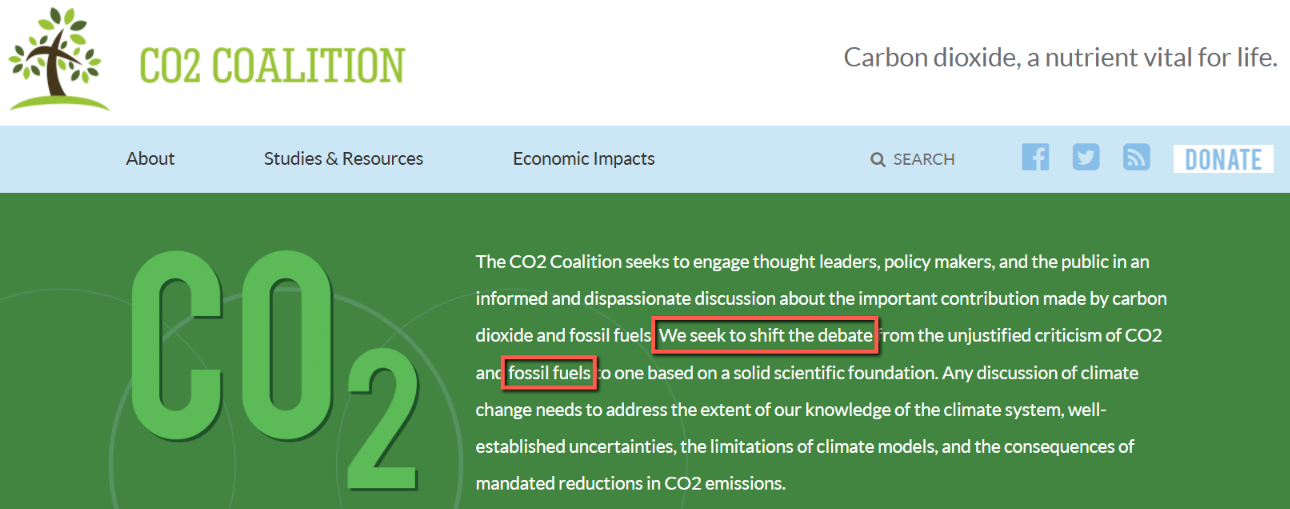
Unfortunately for Tom Nelson, Martin Durkin and the CO2 Coalition, the internet keeps receipts of airbrushing:
Why It’s So Hard to Convince Pseudo-Skeptics

Yesterday Anthony Watts published a guest post on his “Watts Up With That” blog authored by Matt Manos. It is entitled “Why It’s So Hard to Convince Warmists“.

Being a somewhat lazy realist I reproduce it here in full, although be warned that I have used the search/replace function of my text editor a teensy-weensy bit:

Many of the posters and readers at GWC have expressed frustration at convincing pseudo-skeptics. Using facts and logic seem to fall on deaf ears. There are some interesting social sciences theories on why pseudo-skeptics are unresponsive. I know the social sciences aren’t a favoured science with this group but if you’ll bear with me, you’ll hopefully see how social science can be useful in describing why pseudo-skeptics are unreachable. And possibly, what to do about it.

In their latest speeches on global warming, Obama and the Pope weren’t trying to convince pseudo-skeptics that CAGW is real. Instead, they were sending signals to their supporters on what “all right thinking people” should be saying. This is classic in-group/out-group communication. Obama and the Pope were setting up the talking points for their in-group members to use to determine who can be considered part of the tribe and who should be rejected for being outside of it. This is a process called Othering. Othering turns political foes into non-beings. Others have no value. Others can be discounted and ignored. Others can be mocked.

Booker and Rose are examples of bellwethers; the sheep with the bell that the other sheep follow. Bellwether is not a derogatory term, it’s a descriptive term. The job of a political bellwether is to indicate the position that their followers should take in their everyday conversations. Booker and Rose’s latest articles function as position papers for the delegates of all right thinking people. You meet these people at work, church, school, at the coffee house, etc. The delegates will mirror the words that Booker or Rose used to identify other in-group members, normalize beliefs and mock out-group members. One of the main themes of both speeches was shame. Shame on those who aren’t right thinking people. Shame that they aren’t as intelligent and capable as “us.”

That type of smugness is almost impossible to penetrate. When a realist questions a pseudo-skeptic’s view on global warming/climate change, the pseudo-skeptic hears something vastly different than what the realist is saying. A realist might say, “There’s no evidence for an Arctic Ice Recovery.” What the pseudo-skeptic hears is how stupid warmists are because that’s what Anthony Watts told him he should think. If the pseudo-skeptic doesn’t prove that he thinks realists are stupid then he might be confused for a warmist! And no one wants to be identified with being a warmist because they’re mocked and don’t get invited to the right parties. No amount of science can penetrate the ROI the pseudo-skeptic has internalized in not believing in CAGW.

Many of the pseudo-skeptics are running on pure rational ignorance. Rational ignorance is a belief that the cost/benefit to researching every issue is so low as to be a net negative in time utilization. Thus the ignorance is rational and everyone utilizes this mental process on certain topics. People who are rationally ignorant about global warming look to bellwethers that support their gut stance. Rationally ignorant pseudo-skeptics would look to Australian leaders, mockutainers and denialist scientists for guidance on how to communicate their position on global warming.

Penetrating rational ignorance is tough because the position pseudo-skeptics have taken isn’t based on logic. Their position is actually based on an appeal to authority. To question the rationally ignorant denier is to question the field of science as a whole (to be a science realist) or to question the leadership of their favorite bellwether personalities. This will cause the rationally ignorant denier to become defensive and try to stand up for their favorite bellwether. The rationally ignorant will also point to their favorite bellwethers and say, “Who am I to doubt all these intelligent people?” It’s intellectually offshoring. It’s lazy. It’s human nature.

The scientific method rejects outright in-group/out groups, Othering, bellwethers and rational ignorance. A scientist is supposed to follow the results on an experiment even if the results don’t support his hypothesis. The scientist is clearly not supposed to rig the data to ensure he gets invited to a party with the right people or continued funding. But science has a poor track record on controversial topics. It often takes decades to accept new theories that are clear winners (e.g., continental drift).

Scientists are still social animals. Social animals follow hierarchy and incentives. If you really want to win the debate on global warming, change the opinions of the bellwethers. Change the economic incentives for the global warming scientific paper mill. Otherwise you’re stuck debating only the people who are unable to change their minds because it would cost them personally to do so. Rare is the person intellectually honest enough to bite the hand that feeds or is willing to violate social norms to speak the truth.

Please feel free to comment below should you spot any inadvertent errors that necessitate a bit more searching/replacing on my part. In the meantime you may be interested in watching this recording I made of a presentation by Dr. Darren Schreiber of Exeter University at a “Pint of Science” presentation last week, entitled “Your Brain is Built for Politics“:

Note in particular the part at 8 minutes 15 seconds where Darren says:

In a new study that just came out a couple of months ago they showed a single disgusting image, and one single disgusting image and measuring the brain activity and how the person responded to that was sufficient to allow you to identify if somebody was conservative or liberal. With a single brain image. With 95% accuracy!

Tricks Used by David Rose to Deceive

Regular readers of our so far somewhat surreal reporting from up here in the penthouse suite at the summit of the Great White Con ivory towers will no doubt have noticed that we like to concentrate on the facts about the Arctic, whilst occasionally naively exploring assorted psychological aspects of journeying through the “denialosphere”.

Today, however, we’re branching out in a different direction with the aid of our first ever guest post. It has been carefully crafted by Sou Bundanga of the HotWhopper blog, on the topic of the “journalistic tricks that professional disinformers use”. It covers some of the same ground as a recent post of our own, albeit from a rather different angle. If you would like view the original version on Sou’s blog please click here. Alternatively, please continue below the fold:


This is just a short article to show the journalistic tricks that professional disinformers use. It consists of excerpts from an article by David Rose, who is paid to write rubbish for the Mail on Sunday, a UK tabloid of the sensationalist kind. He’d probably claim that he’s just “doing his job”. His job being to create sensationalist headlines and not bother too much about accuracy, but to try to do it in such a way as to stop the paper ending up in court on the wrong end of a lawsuit. Just. (The paper probably doesn’t mind so much getting taken to the Press Complaints Commission. )

Here is what David Rose wrote last weekend:

The Nasa climate scientists who claimed 2014 set a new record for global warmth last night admitted they were only 38 per cent sure this was true.

First of all notice the use of the word “admitted” – as if it was something that the scientists were forced into, whereas in fact they provided all the information in their press briefing. Notice also that David has taken one number and used it out of context.  The 38% number is the probability that 2014 is the hottest year compared to the probability that 2010 and other hot years are the hottest. 2010, the next hottest year, only got a 23% probability by comparison. Here is the table showing out of 100%, what the different probabilities are:


You can see how David misused the 38% number. In fact the odds of it being the hottest year on record are the highest of the lot.

What is David’s next atrocity:

In a press release on Friday, Nasa’s Goddard Institute for Space Studies (GISS) claimed its analysis of world temperatures showed ‘2014 was the warmest year on record’.

The claim made headlines around the world, but yesterday it emerged that GISS’s analysis – based on readings from more than 3,000 measuring stations worldwide – is subject to a margin of error. Nasa admits this means it is far from certain that 2014 set a record at all.

See how David Rose distorts things. How he uses rhetoric, abusing words like “emerged” and “claim” and “admits”. He is also being “economical with the truth” about the “far from certain”. He just made that one up. It may not be “certain”, but it is much more certain than “far from”.  And it is more “certain” that 2014 was the hottest year than that any other year was the hottest year.

If David Rose were arguing that you beat your wife, even though you don’t, he’d probably write it up as:

The so-called scientist claims that he doesn’t beat his wife. He admits that he cannot prove he doesn’t beat his wife. However this journalist can show that it has emerged that his claim is subject to a margin of error.  95% of wife-beaters deny beating their wives.

And I doubt he’d add the confidence limits to the 95% number!

David Rose continues his deception writing:

Yet the Nasa press release failed to mention this, as well as the fact that the alleged ‘record’ amounted to an increase over 2010, the previous ‘warmest year’, of just two-hundredths of a degree – or 0.02C. The margin of error is said by scientists to be approximately 0.1C – several times as much.

That section by David Rose contains the same journalistic tricks of rhetoric, as well as an error of fact. The margin of error of the annual averaged global surface temperature is described in the GISS FAQ as ±0.05°C:

Assuming that the other inaccuracies might about double that estimate yielded the error bars for global annual means drawn in this graph, i.e., for recent years the error bar for global annual means is about ±0.05°C, for years around 1900 it is about ±0.1°C. The error bars are about twice as big for seasonal means and three times as big for monthly means. Error bars for regional means vary wildly depending on the station density in that region. Error estimates related to homogenization or other factors have been assessed by CRU and the Hadley Centre (among others).

If the press release didn’t include any confidence limits, then where did David Rose get his numbers from you may ask? That’s a very good question. It turns out that NOAA and NASA held a press conference, during which they showed some slides and explained the confidence limits, among other things. So David Rose was being very deceitful, wasn’t he. Which isn’t a surprise.

What bit of deception does he swing to next? Well here it is. You be the judge:

As a result, GISS’s director Gavin Schmidt has now admitted Nasa thinks the likelihood that 2014 was the warmest year since 1880 is just 38 per cent. However, when asked by this newspaper whether he regretted that the news release did not mention this, he did not respond. Another analysis, from the Berkeley Earth Surface Temperature (BEST) project, drawn from ten times as many measuring stations as GISS, concluded that if 2014 was a record year, it was by an even tinier amount.

More rhetorical tricks using words like “admitted”. More deception by David Rose. When and how and where did David Rose ask Gavin Schmidt the question? I don’t know. It looks as if it was via an accusatory tweet of the type “have you stopped beating your wife”, like this one on January 17th:


Yet Gavin Schmidt had already responded to David Rose’s tweets about “uncertainties” on January 16th:


That’s about it. I’ll leave it to you to decide who is the grand deceiver.

I’d not trust David Rose, denier journo, with a single fact.  It is alleged that he is a master of deception. He’d probably try to claim he is just doing his job.


Thanks very much for that article Sou, and by way of conclusion here’s yet another tweet from Gavin Schmidt, this time from January 24th:

Some Sceptical Questions

With the able assistance of some of the regular readers of Steve Goddard’s so called “Real Science” blog I have drawn up a checklist of questions to answer should you (or any “sceptics” you may be aware of) be suffering from the delusion that the sea ice in the Arctic is “recovering” or “rebounding”:

Us:

1. Is the NSIDC daily Arctic sea ice extent number for March 8th 2014 the lowest on record for that day of the year? Yes or No?

2. Is the Cryosphere Today Arctic sea ice area number for March 8th 2014 the lowest on record for that day of the year? Yes or No?

3. Is the IJIS Arctic sea ice extent number for March 9th 2014 the lowest on record for that day of the year? Yes or No?

4. What credible evidence can you provide to show that “The Arctic is getting colder”?

5. In what way has the NSIDC’s data been “contaminated by Mann”?

6. Where might one find “empirical data that hasn’t been contaminated” if not from the likes of NOAA/NASA/JAXA et. al.

7. How do you define “The Arctic”? [2014-3-12 16:53]

8. How much sea ice do you suppose will be left in the Gulf of St. Lawrence by September? [2014-3-12 20:26]

9. Which version of “the [thickness/volume] truth” do you choose to believe? [2014-3-14 09:30]

10. When was it that the DMI “changed the way they read/interrupt coastal features [which] they incorporated into their extent/area numbers”? [2014-3-15 15:08]

11. Why have we been accused of “a lie” and “put on ignore”? [2014-3-16 15:12]

12. Please be so good as to provide us with a link that describes “the modeling used by NSIDC to ‘create’ these numbers” [2014-3-20 13:00]

ftp://sidads.colorado.edu/DATASETS/NOAA/G02135/north/daily/data/NH_seaice_extent_nrt.csv

No reply to any seven eight nine ten eleven of those questions as yet.

Them:

In answer to question 7 Steve Goddard “says”

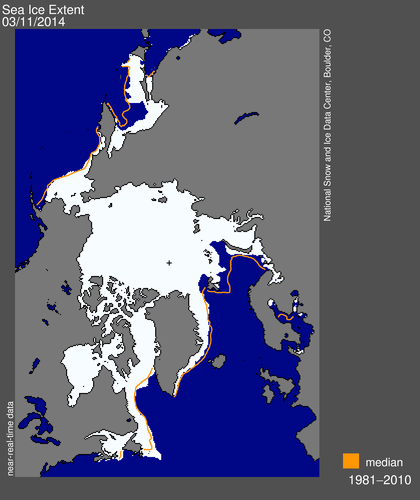
NSIDC visualisation of Arctic sea ice daily extent for March 10th 2014

Then a “Real Scientist” asks a sensible question:

Do NSIDC and DMI define the Arctic differently? If so, by how much?

Us:

We say:

1. Yes Dave.

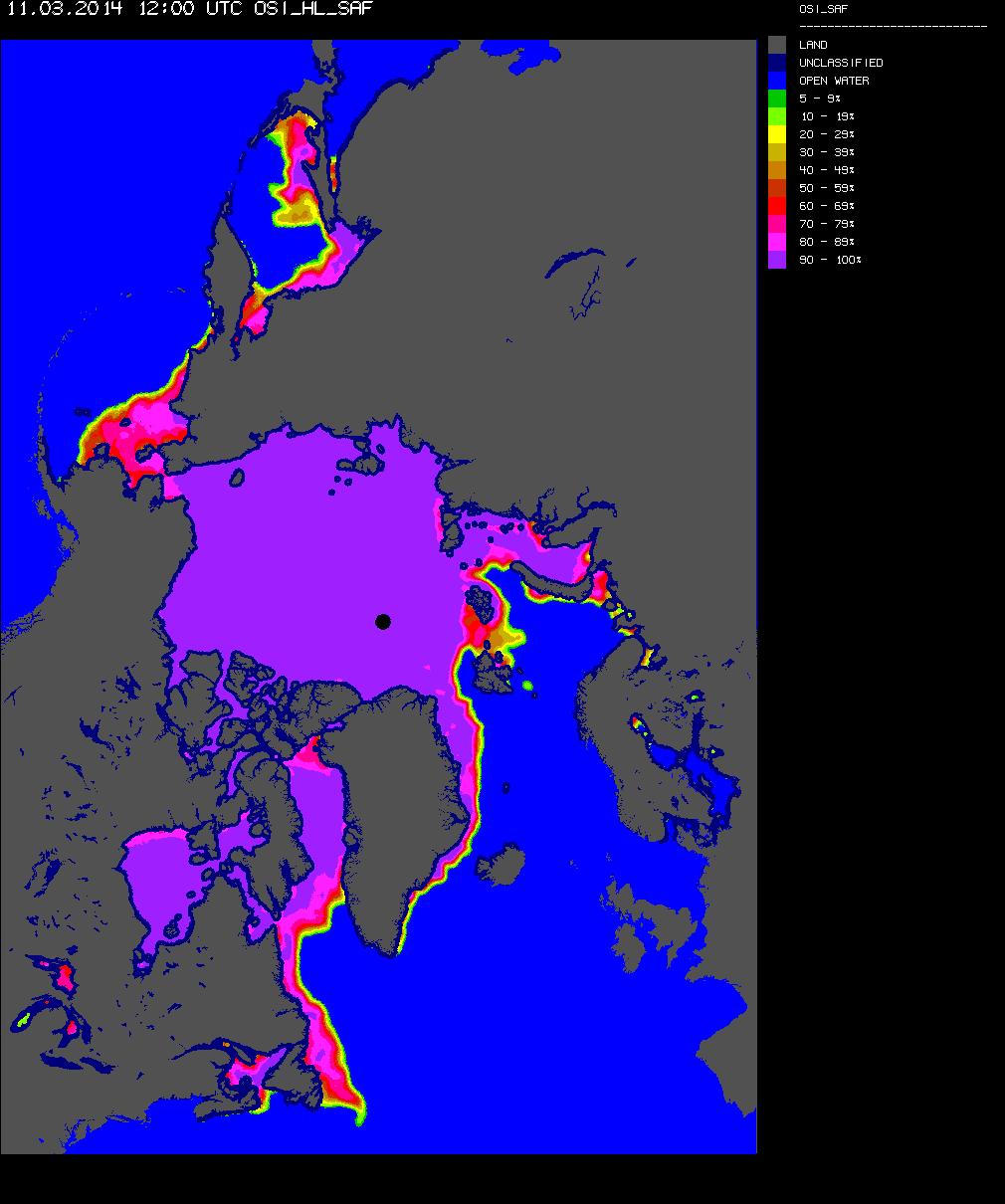
2. Here’s a clue:

OSI Arctic sea ice concentration for March 11th 2014
OSI-SAF Arctic sea ice concentration for March 11th 2014

We’ll keep you posted!