Monthly Archives: September 2014

Mark Serreze and the Arctic Sea Ice Death Spiral

In his article about Arctic sea ice in the Mail on Sunday three days ago David Rose pointed out that:

The most widely used measurements of Arctic ice extent are the daily satellite readings issued by the US National Snow and Ice Data Center, which is co-funded by NASA.

He also stated that:

For years, many have been claiming that the Arctic is in an ‘irrevocable death spiral’, with imminent ice-free summers bound to trigger further disasters. These include gigantic releases of methane into the atmosphere from frozen Arctic deposits, and accelerated global warming caused by the fact that heat from the sun will no longer be reflected back by the ice into space.

Judith Curry, professor of earth and atmospheric sciences at Georgia Institute of Technology in Atlanta, said last night: ‘The Arctic sea ice spiral of death seems to have reversed.’

All of which got me thinking. Why did David Rose speak to a professor of earth and atmospheric sciences when researching his article, rather than an expert on Arctic sea ice? Why, indeed, did he not speak to the man who originally coined the “Death spiral” metaphor? Seeking answers to these troubling questions amongst others, I called the National Snow and Ice Data Center in Boulder, Colorado. I enquired whether I might be able to speak with Mark Serreze,  who is currently director of the NSIDC. Shortly after that Mark called me back and I was able to ask him a number of questions.

My first question was whether David Rose or anyone from the Mail on Sunday had been in touch with the NSIDC recently. The answer was “No”. Next I enquired whether the “Death spiral” story was apocryphal or not. Mark told me he did recall saying something along those lines, but that he couldn’t recall the exact circumstances. Doing my own due diligence (unlike the Mail!) the earliest reference I could find suggested that “the circumstances” involved a telephone interview much like the one I was in the middle of. In an article dated August 27th 2008 the Reuters environment correspondent reported that:

This year’s Arctic ice melt could surpass the extraordinary 2007 record low in the coming weeks. Last year’s minimum ice level was reached on September 16, according to the National Snow and Ice Data Center.

Even if no records are broken this year, the downward trend in summer sea ice in the Arctic continues, the Colorado-based center said. Last year’s record was blamed squarely on human-spurred climate change.

“No matter where we stand at the end of the melt season it’s just reinforcing this notion that Arctic ice is in its death spiral,” said Mark Serreze, a scientist at the center. The Arctic could be free of summer ice by 2030, Serreze said by telephone.

Mark confirmed to me that he still stood by his 2030 estimate for the onset of a seasonally ice free Arctic, although “most models say more like 2050”.

Next I asked him whether he agreed that “The Arctic sea ice spiral of death has reversed.” He said that he agreed with the statement attributed to Dr. Ed Hawkins near the end of the Mail article, that “There is undoubtedly some natural variability on top of the long-term downwards trend caused by the overall warming“. However 2 years worth of data certainly didn’t constitute “a recovery”. It was more like “a one week retracement in the US stock market. The long term trend in extent is definitely downwards”.

In conclusion I asked Mark to offer his best estimate for Arctic sea ice extent at this summer’s minimum. He told me that even at this late stage some of that “natural variability” could affect the outcome, but that the NSIDC extent “will probably end up on a par with 2013”.

I have also had an email conversation with Andrew Shepherd, the British “expert in climate satellite monitoring” whose views about Arctic sea ice were reported in the Mail on Sunday’s article. He told me that:

Arctic sea ice cover is expected to continue to decline, with the possibility of ice-free summers in the next 20-30 years. Climate model predictions tend to be at the upper end of this range, whereas projections of past observations tend to be at the lower end. Once we are able to include direct measurements of thickness from CryoSat-2, I expect the accuracy of predictions will improve.

If nothing else changes, then the recovery in Arctic sea ice thickness will wind the clock backwards a few years, but there is no reason to believe this is anything other than a temporary reprieve due to one cool summer.

Finally, for the moment at least, I also called the Danish Meteorological Institute. Along with the NSIDC their Arctic sea ice extent figures were quoted by David Rose. Along with the NSIDC they told me that they had received no enquiries recently from Mr. Rose or anyone else at the Mail on Sunday.
Santa’s Secret Summer Swimming Pool Revisited

Regular readers may recall that way back when in September 2013 we wondered why David Rose hadn’t seen fit to reproduce any visualisations of Arctic sea ice concentration in a previous article about Arctic sea ice, particularly when his source materials from the NSIDC contained some very nice examples.

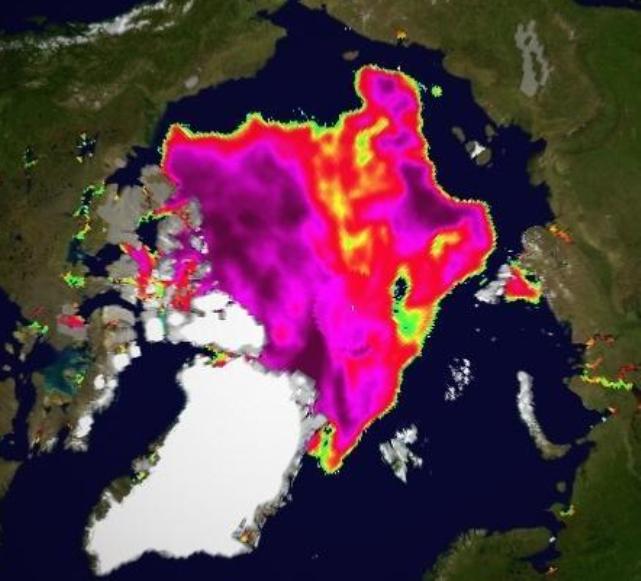
Today we are pleased to be able to inform you that David has now followed our long standing advice, and his article in the Mail on Sunday  yesterday included two such “stunning satellite images”. Of course they are not really “photographic” images, any more than the visualisations of Arctic sea ice extent that David was so keen to show his loyal readers last time around were. Unfortunately David neglected to include a “stunning satellite concentration visualisation” for August 25th 2013 in yesterday’s article. We are pleased to be able to help correct that no doubt inadvertent oversight, albeit somewhat belatedly, with the able assistance of the Department of Atmospheric Sciences at the University of Illinois and their Cryosphere Today web site:

Cryosphere Today Arctic sea ice concentration on August 25th 2013

Paraphrasing David Rose’s article yesterday, can you see all the yellow and green areas denoting regions where the ice pack is least dense?

Can you see “an unbroken ice sheet more than half the size of Europe stretch[ing] from the Canadian islands to Russia’s northern shores”?

Can you see Santa’s secret summer swimming pool, just a short sleigh ride away from his natty North Pole residence?

Answers on a virtual post card please, to the address below.

David Rose’s Apocalyptic Vision of Al Gore’s Nobel Lecture

According to David Rose’s headline in his article about Arctic sea ice in yesterday’s Mail on Sunday:

Stunning satellite images show summer ice cap is thicker and covers 1.7 million square kilometres MORE than 2 years ago…despite Al Gore’s prediction it would be ICE-FREE by now

Seven years after former US Vice-President Al Gore’s warning, Arctic ice cap has expanded for second year in row.

In the first paragraph of his article Mr. Rose continued:

The speech by former US Vice-President Al Gore was apocalyptic. ‘The North Polar ice cap is falling off a cliff,’ he said. ‘It could be completely gone in summer in as little as seven years. Seven years from now.’

Those comments came in 2007 as Mr Gore accepted the Nobel Peace Prize for his campaigning on climate change.

But seven years after his warning, The Mail on Sunday can reveal that, far from vanishing, the Arctic ice cap has expanded for the second year in succession – with a surge, depending on how you measure it, of between 43 and 63 per cent since 2012.

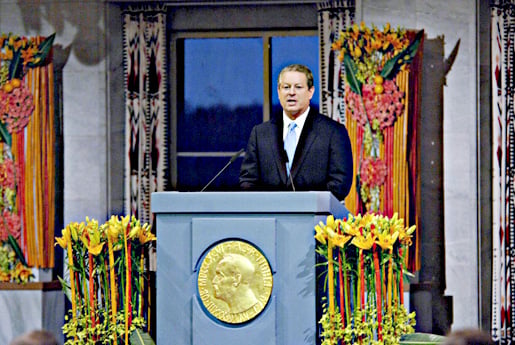
Would it surprise you to learn that when it comes to reporting Nobel Prize acceptance speeches Mr. Rose has as much difficulty separating fact from fiction as he does when reporting on the state of the sea ice in the Arctic? What do you suppose Mr. Gore actually said in his Nobel lecture in Oslo in December 2007? It’s not hard to find out. Here’s a picture of the former US Vice-President at the time:

Al Gore delivering his Nobel Lecture in the Oslo City Hall, 10 December 2007.
Copyright © The Norwegian Nobel Institute 2007 – Photo: Ken Opprann

and here’s a video of the speech he gave:

Skip to 4:30 minutes into the video and you will discover that what Al actually said was:

Last September 21st, as the Northern Hemisphere tilted away from the sun, scientists reported with unprecedented alarm that the North Polar ice cap is, in their words, “falling off a cliff.” One study estimated that it could be completely gone during summer in less than 22 years. Another new study, to be presented by U.S. Navy researchers later this week, warns it could happen in as little as seven years. Seven years from now.

For those who, like David Rose, apparently have difficulty in understanding English I suppose I now need to point out that the “falling off a cliff” phrase should be attributed to some unnamed scientists, not to Al Gore. You will no doubt have noted that Mr. Gore didn’t actually say the words put into his mouth by Mr. Rose, and that the sentiment that “it could happen in as little as seven years” is not in fact “Al Gore’s prediction” at all, and should instead be attributed to some unnamed “U.S. Navy researchers”.

For the hard of hearing amongst you:

Al Gore never “predicted” that the Arctic would be ICE-FREE by now!

Would it surprise you to discover that David Rose has misrepresented the “new study” that Al Gore referred to in 2007 as well, by some strange coincidence at around this time last year? I refer you to our article on that topic from September 15th 2013, and reiterate for the benefit of those who seem unable to understand either English or Mathematics that a “projection” is not the same thing as a “prediction”, and that Professor Wieslaw Maslowski’s statement that “if this trend persists the Arctic Ocean will become ice-free by around 2013” is not at all the same thing as David Rose’s (mis)interpretation that “The Arctic will be ice-free in summer by 2013”.

The obvious conclusion, or so it seems to me at least, is that Mr. Rose should stop pretending to be an investigative reporter and concentrate in future on his evident talent as a writer of speculative fiction.

[P.S. September 2nd 2014]

For some strange reason this post seems to have attracted a lot of interest over on Twitter. Here are the edited highlights!

Us:


Them:


Us:


We’ll keep you posted!