Tag Archives: ARCUS

The Arctic Research Consortium of the United States

Jim Thomson Waves in Ice Webinar

I only found out about this webinar after it had already started. My Arctic alter ego somewhat cheekily suggested to the Arctic Research Consortium of the United States (ARCUS for short) that our research into waves in the Arctic was ahead of theirs, and was rather surprised when they agreed with “her”!

Fortunately the “Ocean Waves in the New Arctic” webinar was recorded, and here it is in its entirety:

See if you can spot the question “Snow White” asked?

Amongst other things, Jim mentioned in his talk coastal erosion due to increased wave action.  That included a flooding event at Utqiaġvik (Barrow) in 2017. Here’s what happened during a similar event there in 2015:
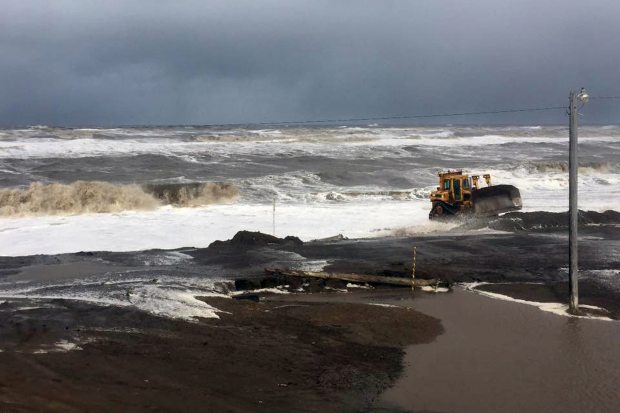
Photograph by Brittni Driver via Alaska Dispatch News

Barrow Battered By Big Waves

Jim also mentioned the erosion of the permafrost bluff at Drew Point, exacerbated by increasing wave action. According to a recent article on that topic:

Eroding permafrost coasts are likely indicators and integrators of changes in the Arctic System as they are susceptible to the combined effects of declining sea ice extent, increases in open water duration, more frequent and impactful storms, sea-level rise, and warming permafrost.

Our results show that mean annual erosion for the 2007–2016 decade was 17.2 m yr−1, which is 2.5 times faster than historic rates, indicating that bluff erosion at this site is likely responding to changes in the Arctic System.

Here’s a video of permafrost disappearing into the Beaufort Sea in 2008:

[Edit – March 1st]

A slightly less technical video from the University of Washington featuring Jim Thomson and some big waves in the New Arctic:
Forecasting Sea Ice Extent in the Dark

My title today refers to the fact that the summer Arctic sea ice forecasting season is with us once again. The ARCUS Sea Ice Outlook (SIO for short) started in 2008, with the aim of gathering together and publishing “community predictions of the September sea ice extent”.  The SIO is now part of the recently created Sea Ice Prediction Network, and the deadline for submission for the first set of forecasts of 2014 was June 10th.

I have a professional interest in UK and international energy policy, and as a consequence I have been commenting on the recent attempts of  Professor Richard Tol to debunk the so called “97% climate change consensus” elsewhere in the blogosphere. As luck would have it I allowed myself to become engaged in what was supposedly a conversation about that very topic on the What’s Up With That blog.  Feel free to read all about it if you’d like to see a pseudo-skeptical gish gallop in full swing:


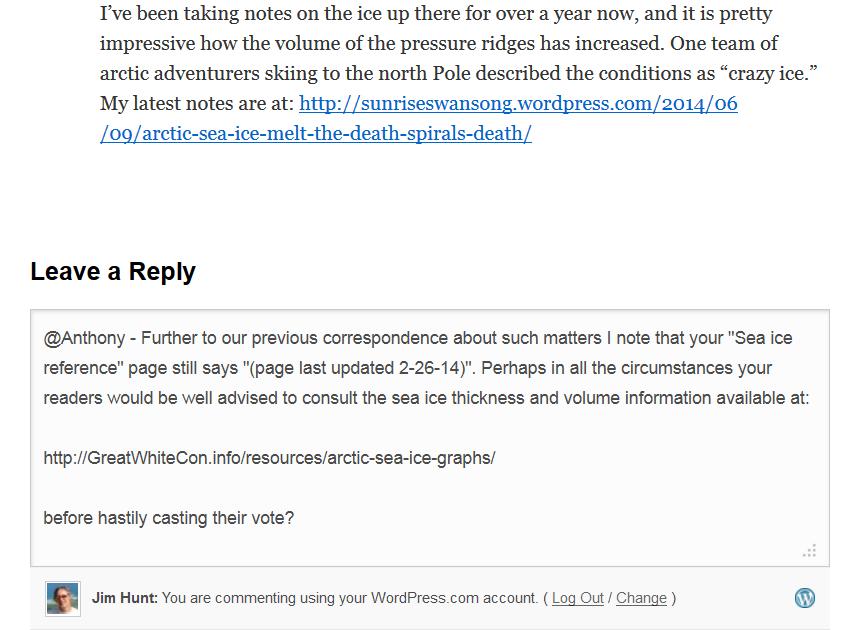
Whilst over there I couldn’t help but notice that Anthony Watts had left things until the eleventh hour before asking his faithful followers to contribute to the Sea Ice Outlook June survey. I also couldn’t help but notice that despite assurances to the contrary a few short weeks ago (and even after my recent “extra heads up“!)  the  WUWT “Sea Ice Reference Page” is still sadly lacking in a wide range of  information about Arctic sea ice thickness and volume. Consequently I figured I would be performing a valuable public service by bringing this to the attention of Anthony and his readers. Here’s what happened after that:

Us:

2014-06-10_1654_WUWT

Them:

June 10, 2014 at 8:55 am

[snip no, we are not going to have you thread-jack again by pushing your own website and own views – Anthony]

Us:

June 10, 2014 at 9:32 am

Re: @Anthony says: June 10, 2014 at 8:55 am
It’s not my “own views” Anthony. In fact it’s a long list of useful facts and figures for anybody attempting to forecast the future of Arctic sea ice. A long list of useful information still noticeable only by its absence from the WUWT sea ice reference page.
 

Them:

REPLY: We aren’t forecasting volume, we are forecasting extent, so again, your views that we should pay attention to volume graphs on your website (your favorite hobby horse) in this extent forecasting exercise are irrelevant. Don’t clutter up this thread further – Anthony.

Them & Us:


Them:

In the absence of a wide range of scientific information concerning the current thickness distribution of sea ice in the Arctic, and after due deliberation about the likely value of the NSIDC Arctic sea ice extent metric in September 2014, Anthony concluded:

A value of 6.12 million sq km will be sent to ARCUS.

Us:

We’ll keep you posted!